
Qua Contemporary Chinese Cuisine
Years after Kei Concepts dreamed of a Chinese-Vietnamese restaurant, it's finally open in Fountain Valley
Long before it had a name – back when Gem Dining was transitioning into Kei Supper Club – Qua was the most mysterious of Kei Concepts’ future plans, established by managerial whispers as a Chinese dim sum and seafood parlor viewed through a Vietnamese lens. Subsequently touted in Kei’s website, social media, and email newsletters for around a year as “Sea,” its name and focus shifted around April 2025, when construction signs went up in a large space at the same Fountain Valley Town Center plaza housing Kei’s earlier Ini, Kin, Rol, and Vox restaurants. For various reasons, dim sum and seafood were deemphasized in favor of a looser concept “inspired by Saigon’s historic Chinatown, Chợ Lớn, and rooted in Chef Viet Nguyen’s family history… Chinese dishes shaped by a Vietnamese backdrop.” Kei’s pre-opening social media posts alternately touted Qua as three or eleven years in the making – the former number likely referring to restaurant design and construction planning, versus initial concept exploration.
Given how long it was in the works – especially considering Kei’s incredible run with the aforementioned restaurants – it was a little surprising that Qua felt somewhat unfinished during its soft opening, specifically in the culinary department; as at all Kei restaurants, service ranged from friendly and attentive to flawless on both of our visits. But five months later, the menu had evolved enough that we were ready for a third visit to settle our views more definitively.
That menu fills two sides of one large piece of cardstock with nearly 60 items, including numerous savory appetizers, dim sum, and soups, seven desserts, and overlapping categories of rice, noodle, and house specialty dishes. Of note, seafood is neither absent nor particularly emphasized here, and there’s very little obvious Vietnamese connection in most of the offerings. Unless you have personal familiarity with Chợ Lớn in Ho Chi Minh City, you may struggle to answer “what’s different?” between Qua and any upscale non-Americanized Chinese restaurant in Orange County.
As just one frame of reference, guests might feel like they’ve entered a parallel universe version of Din Tai Fung without dumplings: The dining room’s frosted glass, tile, and marble accents have a similar level of class, though the cavernous space feels less intimate than the typical DTF, say nothing of Kei’s other restaurants. A central bar with a limited initial cocktail menu is similar to one at the Irvine location of Nep Cafe – seemingly the focal point of the space, but without anything initially wow-inducing. On our first visit, we ordered two soft drinks that turned out to be Chinese sodas served from cans, including a decidedly olive-scented sarsaparilla, an apple soda, and a Melon Ball cocktail that was less distinctive in flavor than looks, then only for the ball of lightly melony granita that briefly sat atop a perfectly clear, glass-height block of ice. Our second visit kicked off with a nice Hong Kong Milk Tea, which arrived with a lightly toasted creme brulee top and jelly cubes inside, and a Lucky Cat mocktail that looked and tasted cocktail-class without any booze.
Over these two visits, our group tried items representing most parts of the menu. From the “cold appetizer” collection, we began with the Sichuan pig ear ($12) and bang bang chicken ($19), which turned out to be the same dish but with quality sliced pig ear in one, and chunked chilled chicken in the other. Each was good – lightly spicy, well garnished with peanuts, and only moderately oily – but in no way distinctive compared with versions we’ve enjoyed at many other places locally. Perhaps our favorite cold appetizer was the chili surf clam ($15), a very ample portion of sliced, chilled red fin-shaped clams with a similar chili-soy dressing, while marinated cucumber ($8) offered a DTF-sized, entirely pleasant portion of chili-vinegared small cucumber slices, onions, peppers, and garlic.
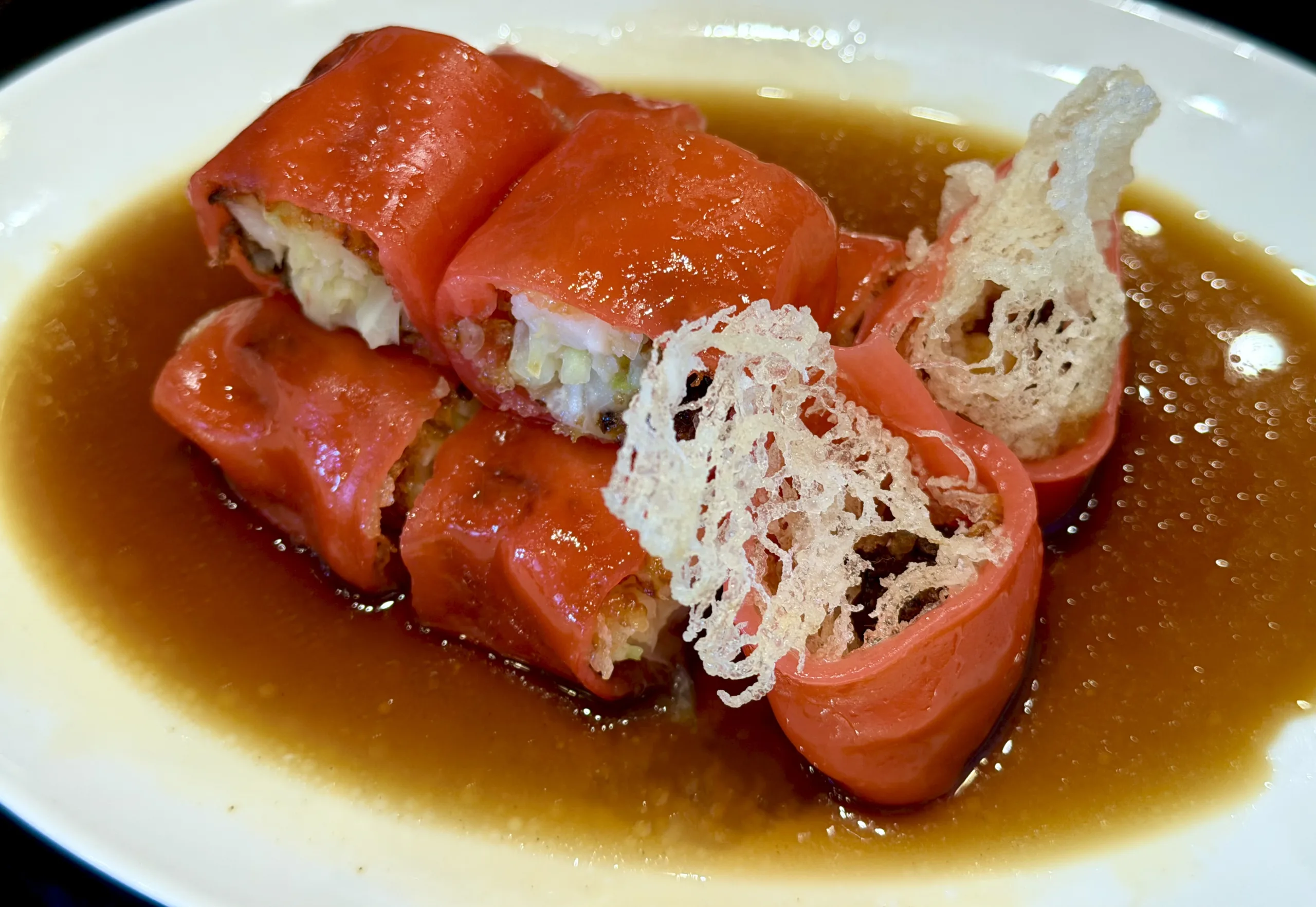
Turning to dim sum, we felt obliged to sample the four-piece shrimp hargow ($10), which offered at least aesthetic differences from the norm. Each crystalline dumpling sported a thinner, more delicate wrapper than typical storebought versions, though the steamer arrived without chili paste or another dipping sauce. Cheung Fun-style shrimp rice rolls ($8.50/3) were underwhelming, served atop a pool of thin, oily soy sauce with two medium-sized shrimp inside. Our immediate reaction was that Seafood Cove 2 had nothing to worry about. However, Qua upped the ante with a more recent addition, crispy shrimp red rice rolls ($9.50), which combine soft and crispy textures with large bites of shrimp and a nice soy-based sauce, poured tableside. These are probably our top dim sum pick at this restaurant on both aesthetics and texture.
Several “pastry” dim sum were mixed bags. Three beautifully presented salted egg yolk lava bao ($9) – initially black buns with gold accents, similar to Lunasia’s pink and gold version, later switched to plain white buns – became better tasting as they lost their visual appeal. A single bolo bao with butter ($4) was a lightly sweetened bread roll with Vermont butter inside, slightly crispy outside and soft inside. Qua was wise not to refer to this by its common English name, as this type of “pineapple bun” is only vaguely shaped like a pineapple and not flavored like one; it wasn’t as sweet or crusty as Seafood Cove’s. A trio of small Portuguese egg tarts ($12) were served with truffle, salted egg yolk, or plain flavors, each good though not $4 good; their price subsequently dropped to $10.
Our group’s favorite item on visit one, Crab Roe Noodles ($27), was one of multiple Qua variants on the same theme – the kitchen is also experimenting with crab roe rice, crab roe and egg glass noodles, and crab roe crispy rice during its soft opening. The bright yellow-orange mix of lump crab, blue crab roe, and claw meat was delightful, but the separately served, modest portion of al dente noodles was hard to split apart and share. It also wasn’t immediately obvious what to do with side dishes of wood ear mushrooms, cabbage, and vinegar; mixing in the first two and omitting the third would have made the experience better. Dan Dan noodles with pork ($15) used the same portion size and style of noodles as their base, but with a thin sesame-peanut-chili sauce, ground pork, and matchstick cucumber slices as toppings; it was equally filling, but good rather than great in flavor. Two soups on visit three, wonton noodle ($18) and braised beef noodle ($19), were yin and yang different in light chicken and heavier, spicier beef broths, but equally delicious and loaded with noodles, proteins, and baby bok choy.
“Dong Po” style braised pork belly ($35) – only available at dinner – was our last savory course on visit one, and from a visual standpoint, a thing of beauty: an island formed by two thick slices of glossy lacquered pork surrounded by baby bok choy trees, floating in a soy-infused lake. But the fat content was extreme to the point where we left at least a third of the belly’s weight behind. Qua offers a side of jasmine rice for $2, but most people would be better off pairing this dish with Lipitor. We ended visit two with a steamed lotus leaf filled with abalone and sausage sticky rice ($11), as well as a pan-fried oyster pancake ($15), the former surprisingly excellent thanks to complex flavors, aromas, and textures, while the latter was just solidly tasty, crispy, and filled with thin-sliced oyster meat.
Desserts are where Qua’s menu strays most from the Chinese theme. On early visits, the best was mango sago pudding ($8), a Hong Kong/Singaporean combination of fresh young coconut slices, coconut sago pearls, and mango pudding in a small glass; we subsequently fell in love with a $7 ginger milk pudding, served warm and full of a sweet, tea-like ginger syrup. Forbidden black rice porridge with young coconut and more of the coconut sago ($8) recalls the complimentary post-meal treats at Oc & Lau, Din Ky, and many other Vietnamese restaurants, while Singaporean-style Kaya Toast ($8) combines toast, kaya coconut jam, and thick rectangles of butter with a soy-honey-poached egg dip. While true to the version we’ve seen in Singapore, the heavy butter and bread flavors somehow overwhelmed the coconut jam, and it wasn’t a hit with anyone at our table. In retrospect, an overemphasis on butters and fats was our biggest concern across savory and sweet courses.
Qua has settled into “solidly good” as its menu has grown to include more dim sum options, and we’re excited to see what’s next: At some point, Vietnamese/Chinese dry noodles and a dedicated duck dish are said to be coming, and we’re hoping for more seafood, too. We’ll certainly visit again as it continues to evolve.
Stats
Price: $$-$$$
Service: Table
Open Since: November 2025
Addresses
16121 Brookhurst St.
Fountain Valley, CA 92708
657.300.8391
Instagram: @quadining