
Long He Chinese Cuisine
Memorable upscale Cantonese Chinese cuisine in a previously forgettable Tustin plaza
In the United States, most Chinese restaurants historically identified themselves as offering “Cantonese,” “Hunan,” or “Szechuan” cuisines, each referring to the characteristic flavoring, cooking, and ingredient choices associated with a city or province in southern China. Orange County residents today are lucky enough to have access to a far wider range of regional Chinese cuisines (see: Noodle Nest, Six Alley, Xibei, Xishang Roodle), and those classic categories have been modified to better align with their Chinese names or modern transliterations. Cantonese cooking is also known as Guangzhou or Yue cuisine, reflecting a focus on the authentic flavors of proteins and vegetables, keeping spice/sauce levels comparatively low, and preferring steaming and stir-frying to dry-frying, oil-braising, or stewing.
As the first U.S. location of a Taiwanese chain specializing in dishes from Guangzhou and nearby cities, Tusin’s Long He Chinese Cuisine (sometimes styled LongHe) offers multiple Cantonese items, as well as individual recipes from Chaozhou (raw marinated shrimp, $18/half, $26/full), Macau (salted fish eggplant in clay pot, $20), and Hong Kong (typhoon shelter prawns with crispy garlic, $28). Without individually naming each of the nearly 80 soft opening menu items, we will characterize the initial list as incredibly compelling and locally very distinctive. Beyond temporary paper menu pages, a smartphone-based ordering system includes beautiful photos of every dish that are extremely close to what’s actually delivered – the products, we learned, of a head chef with over 40 years of experience, unquestionably visible in both Long He’s concepts and execution.
Worth underscoring: We visited Long He three times during its extended soft opening in April, May, and June 2026, a stage when restaurants typically work out small kinks and aren’t up to their full potential. Even at this early stage, the dining room and service style approximate places like Din Tai Fung or Meizhou Dongpo, which is to say a step below fine dining, but with the same Michelin Bib Gourmand-level of aspirational culinary quality and attentiveness. On our first visit, the restaurant was about to install new grill hardware in its kitchen, apparently to add Chinese-style meat skewers and other grilled items to its menu. Old artwork outside from the prior tenant (Roast Fish & BBQ House) was eventually covered up outside by temporary Long He signage showcasing the head chef’s accomplishments – conspicuous elevation of a plaza previously known best for Bodega R-Ranch Market, Yoshinoya, and a Mexican torta sandwich shop.
On our first two visits, we focused mostly on dishes that were particularly distinctive locally, while skipping dozens of more common choices that also sounded worthwhile. At a high level, we’ll note that excellent quality and impressive presentation were consistent across virtually all of the dishes we ordered, so we won’t nitpick either of those elements in describing them; unlike many Chinese restaurants, Long He is comfortable serving guests white plates that spotlight individual items without using vegetables or starches to pad them. Additionally, individual proteins tend to be larger than one might guess from pictures, using jumbo shrimp and big pieces of beef that really benefit from two or three small bites rather than one.
Shortly after placing our first order, our attentive and friendly server delivered two complimentary appetizer items: a plate of candied walnuts (not listed on the menu), and crispy anchovies with peanuts ($6), combining lightly oiled, skin-on Spanish peanuts and small, salty dried fish; only the second was brought over on our second visit, and modified to a new peanut and vegetable dish on our third. In each case, the nuts provided a wonderful sweet/savory contrast to kick off our experience, and helped stave off hunger as we waited for other dishes to arrive from the kitchen. (While our first meal took around 90 minutes, a bit slower than typical pacing, our second and third were properly paced, and service remained excellent throughout.)
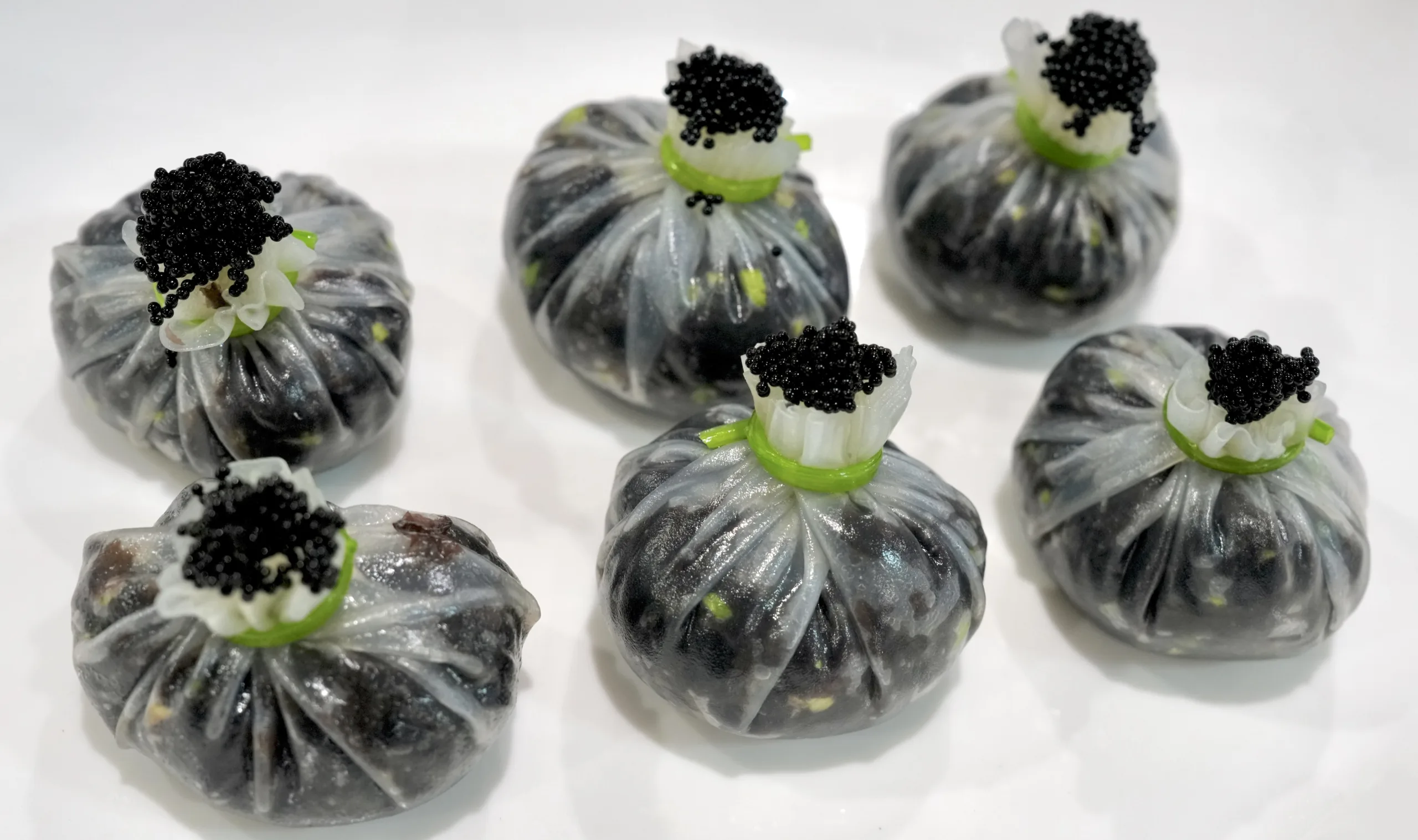
During visit one, seaweed pomegranate dumplings ($12) were the first of our ordered dishes to arrive, and gorgeous: six room temperature, rice paper pouches stuffed with pom-flavored, minced seaweed, sealed with thin seaweed knots, and topped with black roe. Each was simultaneously delicate, plump, and uniquely flavored in ways that only sophisticated chefs can execute at this level – the reason, we were told, that they subsequently disappeared from the menu. Pan-fried stuffed lotus root with wagyu ($22) was one of several Long He dishes starring the wheel-like roots, here placing umami-rich minced beef directly between two peppered lotus slices in utterly savory, oversized Oreo-style sandwiches. Having enjoyed many dishes where lotus stands out, we found this one special in physically fusing the roots to the beef, turning every bite into a contrast of dense root and soft, rich meat.
Next up was crispy prawns with golden shreds ($32), one of the menu’s multiple delicately presented seafood options. Here, the classically sweet, creamy dish walnut shrimp is reimagined without nuts, instead using thin taro strips as a more texturally interesting coating, while placing a stack of deep-fried pumpkin slices at the center. While we loved the shrimp – something we typically don’t say about rare creamy Chinese dishes – the fibrous pumpkin was just a little too dense and unsauced to enjoy in this form, properly prepared yet akin to sweet potato fries that hadn’t softened. It was literally the only thing we would have significantly modified in our meal.
Our final savory course on visit one was slow-cooked crispy beef rib fingers ($26), a set of eight fat finger-shaped pieces of meat that were more complex than photos suggest: Soft, likely sous vide rib meat with concentrated flavor were individually finished with a lightly spicy, sweet glaze that was caramelized to only a millimeter or two of thickness. Each piece yielded three bites of gently crispy, intensely beefy protein that feel more substantial than they were; ideally, the plate’s scattered pine nuts would either adhere to the meat or arrive in a way that enables them to serve as more than an optional nutty note.
During visit two, we were finally able to try the salmon yu sheng, a $38 deconstructed collection of 10 ingredients presented in a circle, centered on a stack of raw salmon and hand-mixed at the table by our server. It had been unavailable on our first visit because the chef wasn’t satisfied with the salmon quality, and turned out to be akin to Chinese-style carpaccio, with prominent soy and ginger flavors. Another raw item, the Chaozhou-style marinated raw shrimp ($18), was a set of six powerfully garlicky, lightly pink shrimp that we liked even more for half the price; the similarly cool Liaoning sea cucumber with tiger salad ($38) included two soft, spiky tubes sliced into multiple pieces, each like spongy squid in texture and flavor, with a fresh onion, pepper, and cilantro base. Claimed to serve two people, it was more medium-sized and appetizer-like than expected, but unique and very healthy as a seafood option.
We also ordered the Macau-style salted fish and eggplant clay pot ($20), a very large portion of soft, sliced eggplant mixed with ground fish and served still sizzling – one of Long He’s best values on size and stomach-filling ability, with an almost miso-like ginger, garlic, and soy sauce. Last and most common was the Cantonese sweet and sour pork ($23), a fairly common Chinese dish executed nicely here with a reasonable crispy batter-to-meat ratio, plus colorful, fresh peppers and pineapple in a tangy, sweet but not overboard sauce. It wasn’t bad in any way, but wasn’t hugely memorable, either.
On visit three, we tried four items we hadn’t sampled before: sizzling three-cup silver cod ($48), a traditional sizzling plate soy-ginger-garlic preparation augmented with big pieces of tender cod and full garlic cloves; four chilled abalone with roasted chili sauce ($28) that were milder than one might guess from the description, but fun to chew and delicious; crispy five-spice pork roll ($19), a more delicate take on yuba rolls with better stuffing and deep-fried skins; and Thai-style curry braised seafood ($38), the rare mixed seafood dish to add chunks of sea cucumber to large prawns, squid, and a fairly standard yellow curry/vegetable base. Paired with six included slices of butter-crisped bread, this dish wasn’t cheap, but offered better value than the cod.
For a deeper dive into Long He’s sweet capabilities, we ordered the menu’s only dessert – mango pomelo sago ($10) – which turned out to be more distinctive in looks than flavors. Picturesque individual strands of grapefruit-like pomelo citrus dominated the bowl, obscuring small mango cubes and transparent sago balls to the point that they were barely visible, even when mixed with the silky puree of chilled mango and coconut milk underneath. There are many ways to serve this dessert, rebalancing sizes and portions of the core ingredients, and we found Long He’s version to be good rather than wow-inducing.
As is the case at many other new and regionally specific Chinese restaurants in Orange County, dining at Long He is fairly expensive, and its forgettable plaza location may initially make you wonder whether it could possibly deliver anything worthy of its prices. Our strong recommendation is to look past any preconceived notions you may have on these topics and give this place a try – particularly after its soft opening dust has settled. Dining room TVs featuring videos from Long He’s Taiwanese locations were spotlighting elaborate poultry preparations and ingredients not yet reflected in the menus we ordered from, hinting at even greater things to come in the near future.
Thanks to an ambitious kitchen, great things are already happening at Long He, and unless something major changes, we expect it to become a must-visit destination for true Chinese food connoisseurs. Even after our two visits, we are actively looking forward to future meals here, especially to see how the menu expands; our plan is to update this article with more photos and details over time.
Stats
Price: $$-$$$
Service: Table
Open Since: April 2026
Address
1046 Walnut Ave.
Tustin, CA 92780
949.966.6888