
Afuri
Costa Mesa scores the first Orange County location of this Japanese, yuzu-hinted ramen chain
When Afuri announced its soft opening at the Costa Mesa plaza known for Blue Bowl, Capital Noodle Bar, Izakaya Hachi, Uncle Tetsu’s Japanese Cheesecake, and Wanderlust Creamery, some people were surprised to learn that the space’s prior tenant Hakata Ikkousha Ramen had closed. But the result is a net gain: As the latest in a long string of Japanese businesses that have set up shop here, Afuri’s first Orange County outlet joins over 30 prior locations – two-thirds in Japan, one-third in Hong Kong, the U.S., and Canada – in offering a somewhat unique take on ramen alongside gyoza, sushi, Japanese small plates, drinks, and desserts.
Known in some cities as Afuri Ramen and Dumpling (and in Portland, Oregon as Afuri Izakaya), Afuri has a somewhat confusing backstory. In 2001, its predecessor Zund-Bar opened in Kanagawa, Japan near Mount Oyama – also known as Mount Afuri. Pure water taken from the base of the mountain for use in ramen inspired the 2003-vintage Afuri name as new locations opened in Tokyo, then spread outside the country. While Zund-Bar remains open, and a fountainhead for the rest of the chain, individual Afuri locations vary somewhat in menus, generally with ramen and small plates at the core, sometimes with dumplings and/or sushi as well.
In practice, Afuri’s chicken stock-based broth is deliberately thinner than many of the fatty pork ramen stocks out there, atypically combining a splash of yuzu citrus with more common salt or soy tare, thin noodles, and a handful of common ingredients. Japanese locations allow guests to choose the amount of chi-yu, or chicken oil, they prefer to thicken and flavor the broth; U.S. locations stick with a lighter (“classic”) balance. Additional pork-based ramen, yuzu-less chicken ramen, and vegan spicy miso with cashew and sunflower seed ramens are also available, as are two tsukemen dipping noodle versions; thicker noodles are used in some of these recipes. Most of the bowls are $19.50 to $23.
Worth a note: Afuri’s beverage menu is surprisingly significant – two pages of a five-page menu card – and includes cocktails, wine and champagne options, sakes, beers, and non-alcoholic drinks. Frozen Afuri yuzu lager, made in-house, is available for $10.50 a glass, and a handful of mostly citrus-themed cocktails can be had for $13 to $16. Costa Mesa’s Afuri has around half as many drink choices as LA’s Afuris, but they still represent a substantial fraction of the menu, and the bar takes up a major part of the new dining room.
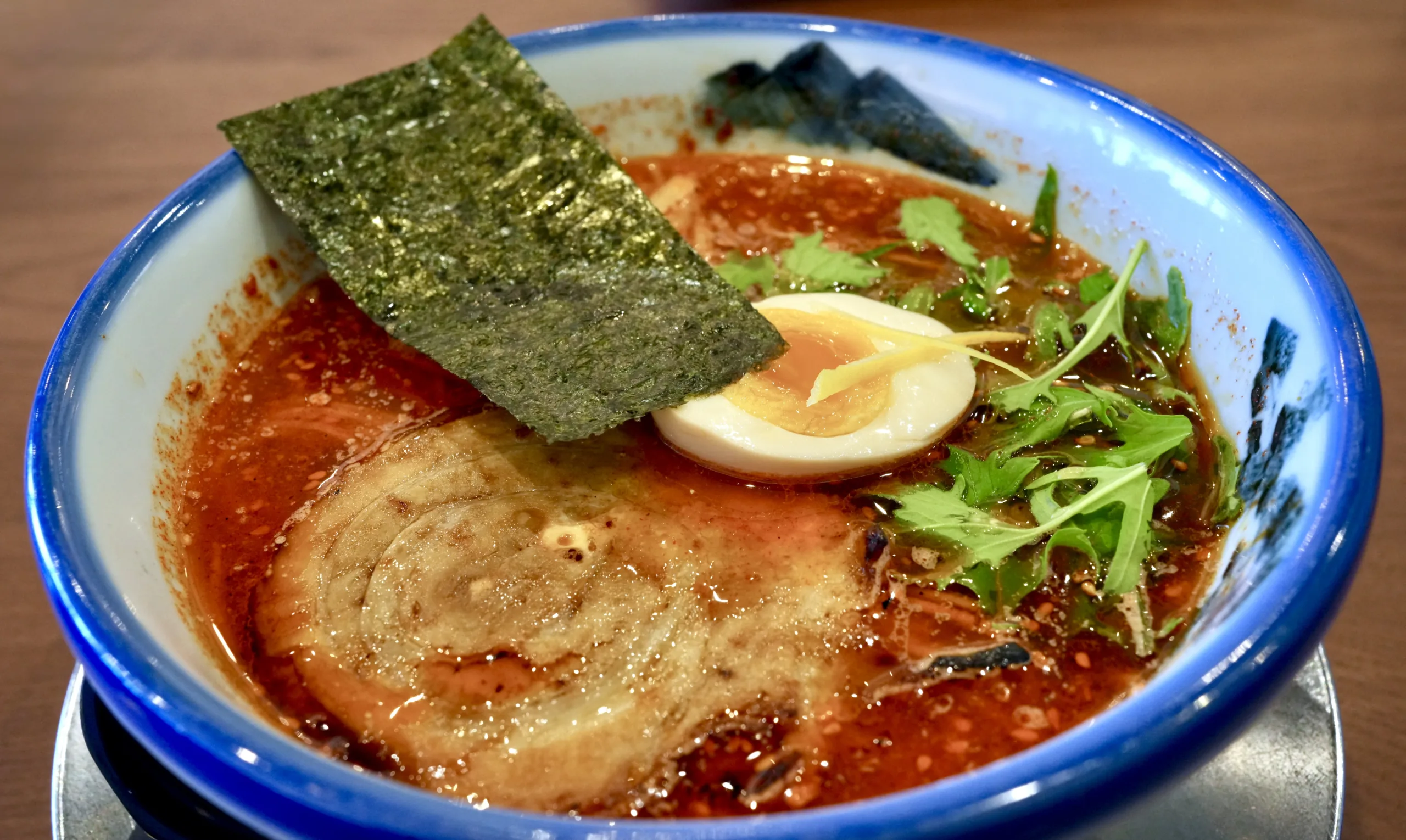
To get a sense of how yuzu differentiates Afuri’s ramen, we first sampled the Yuzu Ratan ($20), a spicy soy/shoyu and chicken broth version with one slice of chashu, a half-egg, one piece of nori, bamboo shoots, greens, and a fist-sized ball of thin ramen noodles. We nearly loved the broth, which managed to combine mild spiciness, deep soy and chicken flavors without a ton of oil or fat – there was no guilt in slurping up most of the soup after enjoying the other ingredients. That said, Afuri’s use of yuzu was mostly obscured by the other flavors, manifesting mostly as a light but pleasant enough background sourness.
On our second visit, we opted for the spice-free Yuzu Tsuyu Tsukemen ($20.50), thick, wavy dipping noodles that can be ordered cold (and chewier) or hot for dipping in a room temperature yuzu-soy dipping sauce. With this dip, the citrus flavor was more obvious – close to typical ponzu – though marinated pork belly cubes and fermented bamboo shoots were already powerfully seasoned, and didn’t need the dip as much as the noodles.
In both of these bowls, the noodles arrived just a touch softer than al dente (without customization options) and tasty, though not remarkable in any way, and Afuri’s small noodle portion sizes left us with plenty of room for other dishes. Additional thin noodles can be added for $4, with thick ones at $5, and you’ll likely need to do so to fill up on ramen here. Afuri’s value proposition just isn’t as strong as, say, Kin Craft Ramen’s.
Additional items were all of good quality. Our favorites of the bunch were a strong, fresh-tasting yuzu limeade ($7) topped with extra yuzu juice – a better value than the complex-sounding but unremarkably flavored kosho margarita ($16) we ordered on our second visit – and the assorted tsukemono ($6.50), a collection of cucumber, cabbage, and daikon slices alternating between soy, yuzu, and smoke pickling techniques to create unique contrasting flavors. Yuzu shio edamame ($7) steamed common soy beans with yuzu and salt to make the pods extra-pliable; scattered bits of crispy garlic punched up the edamame’s gently sour and salty tastes.
Two types of Afuri Gyoza are available but not illustrated on the menu, making ordering tricky. On our first visit, we ordered the “crispy” version ($9/5 pieces, $16/10), which arrived deep-fried and looking pretty nice, but required a mayo and sweet chili oil dip to transcend its flat, basic flavors. We had actually wanted to try the “pan fried” version ($10/6 pieces), and did so on our second visit; similarly unremarkable in filling, it arrives with a slightly crispy, doily-like connective topping and soy vinaigrette dip, which collectively elevate the texture and flavor a little.
We were less impressed by Afuri’s crudo, sashimi, and sushi dishes, but mostly for value reasons. Sanmi crudo ($25) drenches nine thin slices of tuna, king salmon, and yellowtail in an olive oil/lemon dressing lightly flecked with Maldon salt, capers, chives, shallots, and capers. Sashimi moriawase ($30) includes ten thin pieces of salmon, tuna, yellowtail, shima aji, and lemoned scallops. Both were tasty, but not standouts, and pricey for their portion size. To sample Afuri’s sushi, we ordered the soft shell crab roll ($20), which arrived with only five pieces and didn’t have a lot of obvious crab flavor – it was dominated more by sesame seed, avocado, and pickled burdock inside and outside the rice. Again, it wasn’t bad, but we wouldn’t order it again at that price.
Given the choice of either Basque cheesecake ($11) or matcha tiramisu ($12) for dessert, we initially opted for the latter, and really enjoyed it: Like Afuri’s ramen, the tiramisu is light, nicely flavored as expected, and properly textured; unlike the ramen, the tiramisu slice was generously sized. On our second visit, we ordered the cheesecake, and were quite impressed by how Afuri’s additions of lightly sour yuzu curd and hazelnuts (that weren’t particularly “candied” as per the menu) built on the classic Basque recipe, which thankfully wasn’t overly tangy, wet, or goat cheesy here. We’d order either of these desserts again.
After two visits to Afuri, several consistent themes emerged: Both meals were fairly expensive, not entirely filling, and mildly distinctive in flavors. We think yuzu fans will find plenty to like here, even if fans of big ramen bowls and thick cuts of raw fish may struggle with the need to order (and pay) disproportionately more for locally common items. That said, we appreciated the service, which was consistently friendly and fairly quick, and we left without feeling grossed out by the oil and fat in our dishes, which isn’t always the case. By comparison with other OC ramen shops, Afuri isn’t a must-visit, but it’s a fine addition to the plaza, and solid replacement for Hakata Ikkousha.
Stats
Price: $$-$$$
Service: Table
Open Since: 2001/2003 (Japan), 2026 (OC)
Address
3033 Bristol St. Unit 131
Costa Mesa, CA 92626
Instagram: @afuri_la